


-
Sep 17, 2026
Proposed Redevelopment of the Cordova Bay Community Club
Whose Community Club Is It?
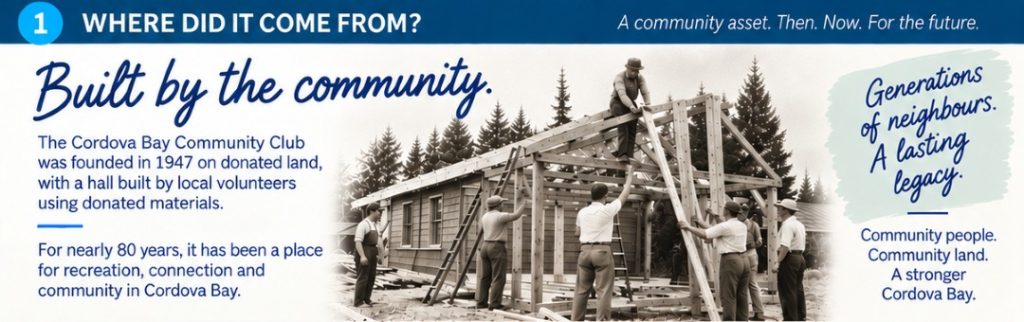
If you live in Cordova Bay, you could be forgiven for not knowing that we have a community club. Tucked away at the end of Sutcliffe Road sits the Cordova Bay Community Club — a nonprofit society with roots in the community going back to 1947. Today, most people who know the building know it for badminton.
What many residents may not know is that the property was not purchased by today’s users or built as a private sports facility. According to CBCC’s own 2025 financial statements, the land was originally donated and volunteers provided the building materials. Today, the property is assessed at almost $3 million. It is an inherited community asset, and now plans are advancing for a major redevelopment of it — including an eleven-court racquet-sports facility centred on badminton. That raises a question Cordova Bay should have been asked long before now: What is our Community Club actually supposed to be?
From community club to badminton facility
There is nothing wrong with badminton. It is healthy, popular and has been part of the Community Club for many years. But there is a difference between a community club that offers badminton and a badminton club calling itself a community club.
CBCC’s own numbers make that distinction increasingly difficult to ignore. In the year ending March 31, 2025, CBCC reported $178,676 in total revenue. Badminton alone generated $132,965, while pickleball generated a further $12,095. Badminton is clearly the financial engine of the Club; pickleball is a much less significant part of the operation. Hall-rental revenue? Thirty dollars.
The CBCC’s public presence tells much the same story. Its CourtReserve directory contains more than 700 “players,” and its advertised programming centres on badminton drop-ins, training, private lessons, court rentals, pickleball and Kung Fu/Tai Chi. The issue is not whether those activities belong there. They do. The question is whether one successful recreational program has gradually come to define the institution itself.
What does the CBCC’s Constitution say?
CBCC was not established simply to operate badminton courts. Its stated purposes include promoting fellowship, sponsoring sports and social activities in the community, and supporting the advancement of the community. Its bylaws contain no special class of badminton members. Ordinary membership is open to adults who pay the annual fee, and those members vote on the affairs of the Society.
The bylaws also state that the CBCC is to operate without gain for its members and that its profits and other accretions must be used to further its purposes. That provision is expressly unalterable. So the issue is not whether badminton fits within CBCC’s mandate. It plainly does. The issue is whether the broader mandate has become secondary to the sports operation.
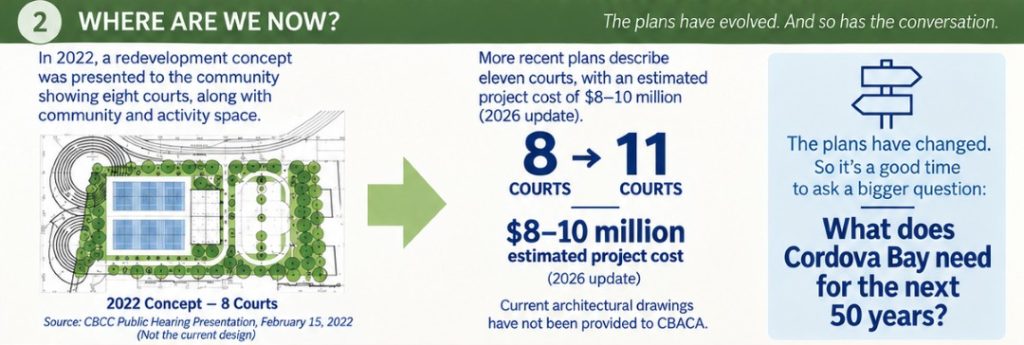
Eight courts became eleven
CBACA supported a redevelopment concept presented in 2022. That proposal showed eight courts. The more recent design shows eleven. We should be candid about our previous support: knowing what we understand today, CBACA would be asking much harder questions about the 2022 proposal as well.
The problem is not simply that eight courts became eleven. The more important question is whether the redevelopment ever began with a proper assessment of what Cordova Bay itself needs. Was there a community-needs study? Were families, teenagers, seniors, community organizations and residents who do not play badminton asked what is missing? Were alternatives for this rare community site explored before the building program was established?
There has clearly been substantial thought about what CBCC’s existing operation requires. It is much less clear how much thought has been given to what the broader community requires — and those are not necessarily the same thing.
The financial stakes
The scale of the proposed redevelopment becomes more consequential when financing enters the picture.
In a June 2026 update to members, CBCC estimated the proposed facility would cost $8–10 million. President Tashin Gee said the Club was assembling a financing package that included existing and prospective investors, loans and other funding sources. Investors were being offered an expected annual cash yield of 6–7 per cent after occupancy, while CBCC was also pursuing approximately $2 million in federal funding.
This would represent a profound change in CBCC’s financial position — particularly because the existing organization appears to be financially healthy. For the year ended March 31, 2026, CBCC reported $176,012 in revenue, $47,484 in expenses and a surplus of $128,528, along with approximately $668,000 in cash and term deposits. Revenue came mainly from badminton, pickleball and interest.
This is therefore about considerably more than replacing an aging hall. A financially healthy community nonprofit is contemplating an $8–10 million redevelopment supported at least partly by loans and private investment carrying an expected return — and what operating model will be required to sustain it.
How much revenue will the new building need to generate each year to meet its financing obligations, provide investors with their expected return and operate a substantially larger facility? And if that model depends on keeping eleven courts heavily booked with revenue-producing activities, what room remains for the broader community purposes in CBCC’s Constitution?
CBCC’s bylaws recognize the significance of placing financial obligations against the property. A mortgage, charge or other security requires approval from at least 75 per cent of the members present and entitled to vote at a properly noticed meeting. Yet only three members are required for quorum.
That means a decision carrying potentially enormous long-term consequences for a multimillion-dollar community property could be made at a meeting attended by only a small fraction of CBCC’s membership. That may satisfy the bylaws, but minimum procedural compliance is not the same thing as meaningful participation.
The concern is not that CBCC should never borrow money or seek investment. It is that the financing structure itself could shape how this community property must operate for many years. Before those commitments are made, Cordova Bay deserves to understand what is being built, how it will be paid for and whether that financial model leaves meaningful room for the broader community CBCC was established to serve.
Who was asked?
This brings us to perhaps the most important question: who was asked? Cordova Bay residents were not presented with several possible futures for this property. They were not broadly asked what facilities or programs the community lacks, what other futures might be possible for this property, or whether an eleven-court badminton-centred facility represents the best use of one of Cordova Bay’s few significant community sites.
Recent correspondence has done little to resolve that concern. Cascadia Architects has offered to meet with CBACA to explain the current plans, but has indicated that authorization from CBCC is required before the drawings themselves can be shared. CBACA has therefore asked CBCC to authorize their release so residents can see what is now being proposed.
CBCC has also responded to questions about the redevelopment and its financial model. Those exchanges have clarified an important point: CBCC says the number of courts was increased from eight to eleven because the additional court revenue was needed to make the proposed investment financially viable.
What those exchanges have not identified is the broader community-needs process that should arguably have come first: asking Cordova Bay residents what they need from their Community Club before the building program was established.
Explaining a completed design is not the same thing as consulting a community about what should be designed.
As far as CBACA has been able to determine, there has been no broad community consultation proportional to the scale of the decision being made.
That matters because this is not simply a building owned by a private sports operator. The land was donated, the original hall was built through volunteer effort, and the organization exists for community purposes. Today’s directors are responsible for managing CBCC, but they are also stewards of an institution and property handed forward by previous generations.
Public money raises the stakes
CBCC has advised members that it was shortlisted for approximately $2 million in federal funding. If substantial public money is being sought, some straightforward questions deserve answers: Who is this building for? What demonstrated community need does it address? What public benefits were represented in the funding application? What financial obligations will be placed against the property? And how does the redevelopment advance the full purposes of the Cordova Bay Community Club rather than primarily expanding its existing sports operation?
Those are not anti-badminton questions. They are questions of public benefit, governance and stewardship.
Time to look again
None of this means CBCC should not be redeveloped. It should. Nor does it mean badminton should disappear. It shouldn’t. But redevelopment of donated community land is a rare opportunity, and the decisions being made now could define this site for decades.
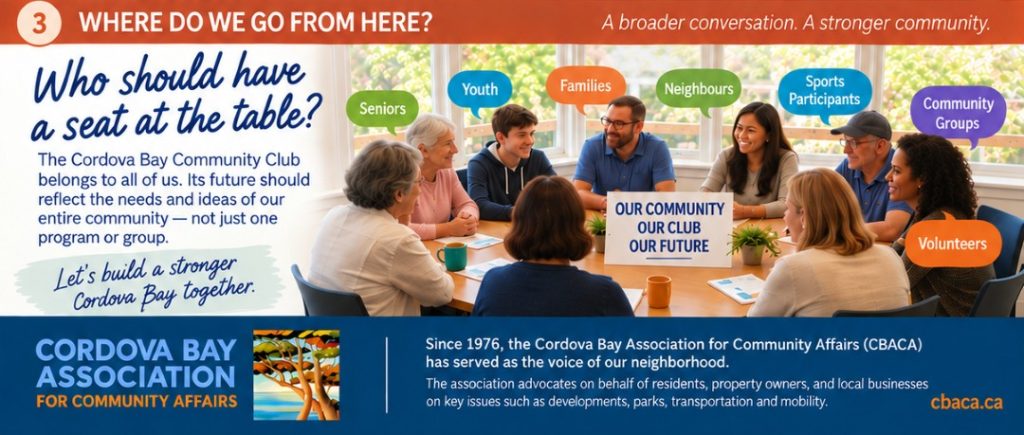
CBACA has already begun acting on these concerns. We have written to the Cordova Bay Community Club, Cascadia Architects, the federal Minister responsible for the Build Communities Strong Fund, the Mayor of Saanich and MP Elizabeth May. We have raised questions about the redevelopment, its financing and public funding, CBCC’s broader community mandate, and the process by which the current proposal was developed.
But residents should understand something important: CBCC is a membership society. Change does not have to come only from outside the organization. It can come from within.
Ordinary membership currently costs $25 per year. Under CBCC’s bylaws, ordinary members have voting rights, and members who have been in good standing for the required period can vote on matters brought before the membership and participate in the election of directors.
I encourage residents who care about what happens next to join CBCC now. Members must be in good standing for at least 30 days before a meeting in order to vote, so waiting until an important decision is announced may be too late to participate.
Before decisions of this scale become difficult to reverse, Cordova Bay deserves a meaningful say in what this property becomes.
After all, whose Community Club is it?
